



The Architecture of Private Aviation
There is a profound difference between wealth and true autonomy. While commercial first-class travel offers comfort, private aviation serves as the ultimate expression of direct control over one’s time and spatial mobility. To understand the world of Private Jets (PJs) is to look at the intersection of extreme engineering, historic ambition, and the relentless pursuit of seamless corporate execution.
1. The Genesis: The First Private Jet Ever Flown
While many aviation enthusiasts point to the iconic Learjet 23 from 1964 as the dawn of the industry, the true title of the world’s first dedicated business jet belongs to the Lockheed JetStar, which took to the skies on September 4, 1957.
[1957: Lockheed JetStar] ───> (4-Engine Corp Giant)
[1964: Learjet 23] ───> (First Personal Jet)
[2026: Ultra-Long-Range Dynasties]  ───> (Mach 0.90+ Penthouses)
Originally conceived as a military utility design by Lockheed’s legendary “Skunk Works” team under Kelly Johnson, the genius behind the SR-71 Blackbird, the JetStar completely redefined elite travel. Boasting a four-engine rear-mounted configuration, a pressurized cabin, and a cruise speed of 565 mph, it instantly caught the attention of global icons.
It quickly became the private carriage of choice for international monarchs, American presidents, and rock-and-roll royalty like Elvis Presley, who famously outfitted his JetStar with custom red velvet seats and wood paneling.
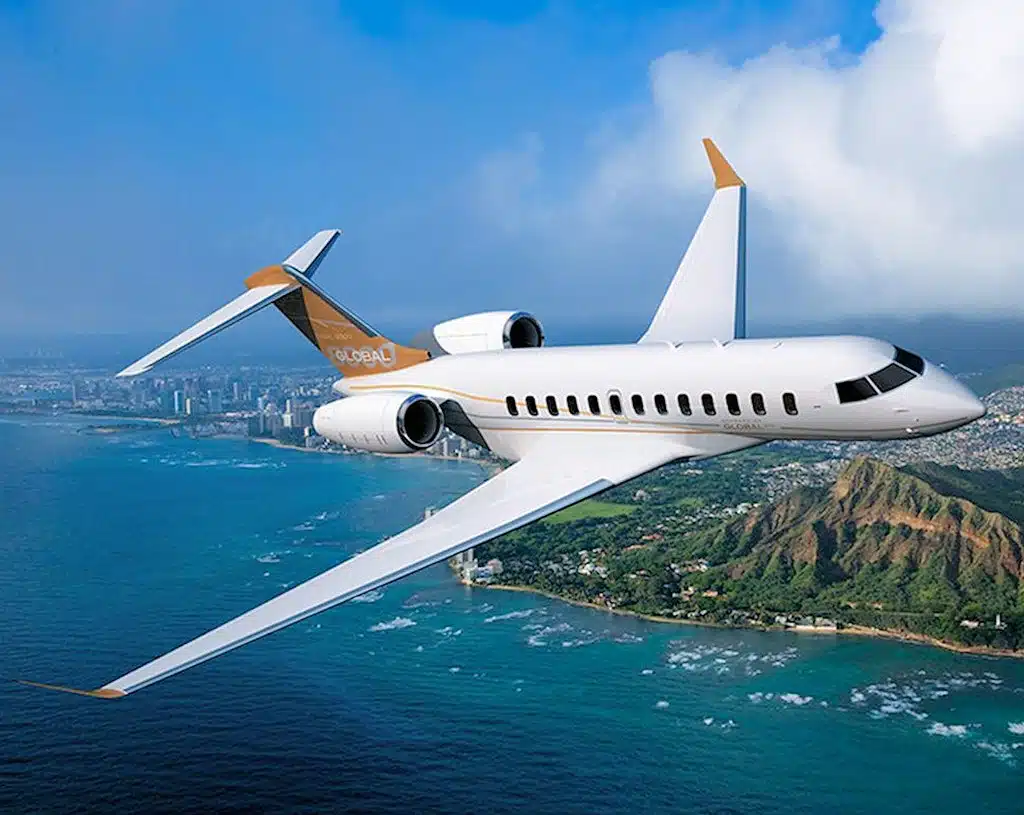
2. The 2026 Heavyweights: The Best Private Jets in Operation
The private jet industry has entered an era defined by ultra-long-range capabilites and low cabin altitudes designed to eliminate jet lag entirely. The global market is dominated by a fierce rivalry for the title of “the best.”
The Sovereign of Speed: The Bombardier Global 8000
The Canadian aerospace masterpiece currently reigns as the fastest and longest-range purpose-built business jet in the world. Flying at an astonishing top speed of Mach 0.94 with an 8,000 nautical mile range, it features advanced Smooth Flĕx Wing technology that acts like an aerial shock absorber to nullify turbulence completely.
The Gold Standard: The Gulfstream G700
Valued at approximately $75 million, the G700 is the undisputed benchmark of executive presence. Its cabin can be configured into five distinct living zones, including a grand master suite with a walk-in shower. It boasts 20 panoramic oval windows, the largest in aviation, and replenishes its cabin with 100% fresh, plasma-ionized air every three minutes, maintaining a cabin altitude of just 2,900 feet while flying high above commercial traffic.
3. The PJ Philosophy: Why the Elite Invest in the Sky
For the modern executive, renting or owning a private jet is not a shallow statement of vanity; it is a calculated capital calculation.
- The Velocity Index: Commercial travel requires hours of terminal delays, security checkpoints, and fixed schedules. A private jet converts any regional airfield into a personalized departure gate, allowing founders to hit three distinct cities for meetings in a single afternoon and return home by dinner.
- Absolute Privacy: In high-level enterprise, data security is paramount. The cabin of a Gulfstream or Bombardier operates as a secure, airborne boardroom where sensitive corporate acquisitions, state policies, and multi-million dollar investments can be negotiated without the risk of interception.
The Classiq Style Takeaway: You can always earn more capital, but you can never manufacture more hours. Private aviation is the ultimate investment because it effectively distorts time, allowing global leaders to move with absolute velocity while preserving the mental clarity required to dominate the market.