
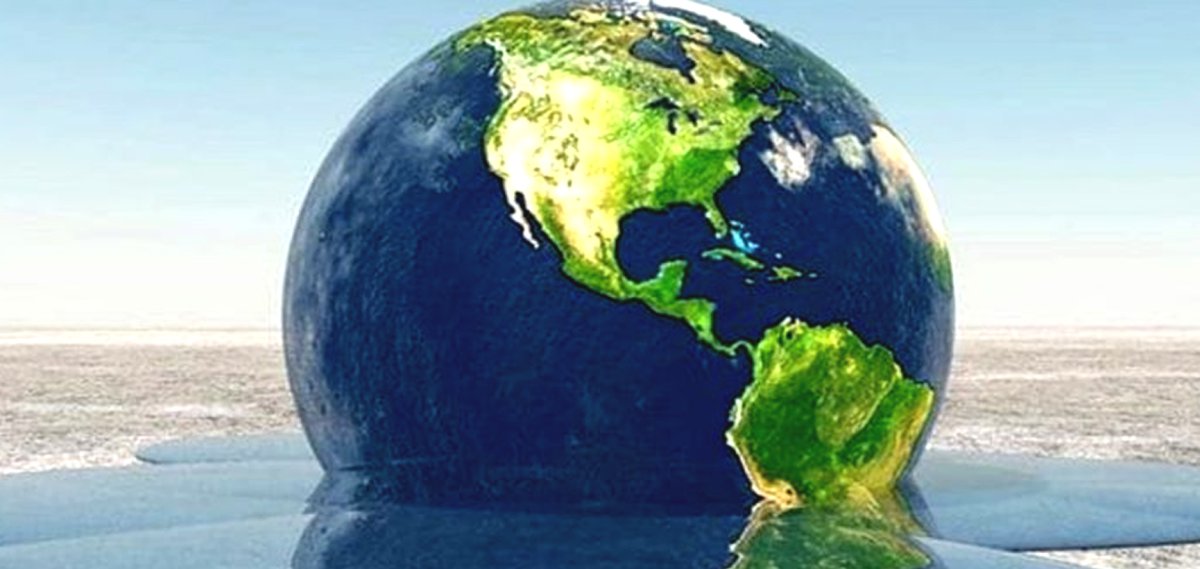
The invisible cost of a changing world
Every generation inherits a world it did not build.
But every generation also inherits the consequences of the decisions that built it.
For much of modern history, we treated the natural world as if it were an unlimited account.
Land could be developed.
Water could be consumed.
Energy could be extracted.
Forests could be cleared.
Cities could expand.
The bill, if there was one, belonged to someone in the distant future.
That future has arrived.
And the climate is beginning to rewrite the ledger.
THE PRICE OF STABILITY
Civilisation depends on predictability more than we realise.
Farmers need seasons they can understand.
Cities need reliable water.
Businesses need dependable electricity.
Ports need functioning coastlines.
Insurance companies need risks they can reasonably price.
Investors need assets whose future can be modelled.
For thousands of years, the relative stability of Earth's climate provided a quiet foundation beneath all of this.
We rarely called it an asset.
We simply assumed it would always be there.
Now that assumption is becoming more expensive.
A changing climate does not simply mean warmer temperatures.
It means that some of the conditions upon which our systems were designed are becoming less predictable.
And unpredictability has a price.
WHEN RISK BECOMES VALUE
Consider a piece of land.
Two properties can look almost identical on a balance sheet.
Same size.
Same location.
Similar construction.
Similar market value.
But what happens when one is exposed to increasing flood risk, unreliable water supply or extreme heat while the other is not?
The difference may not be visible from the estate agent's photograph.
It exists in the future.
The same principle applies to factories, farms, warehouses, hotels, roads, power systems and entire cities.
Climate risk is increasingly becoming asset risk.
And once risk enters the equation, value changes.
This is where climate change stops being an environmental conversation and becomes a conversation about capital.
THE AFRICAN QUESTION
For Africa, the conversation is particularly important.
The continent is still building much of the infrastructure that will define its next century.
New cities.
New roads.
New housing.
New industries.
New energy systems.
New food networks.
New digital infrastructure.
That creates a challenge—but also an extraordinary opportunity.
A road built today can be designed for tomorrow's conditions.
A building can be designed to consume less energy before the first brick is laid.
A community can combine solar generation and storage rather than waiting for a perfect centralised grid.
Agriculture can become more intelligent about water, soil and changing growing conditions.
Infrastructure does not have to inherit the weaknesses of the past.
Africa is still writing its ledger.
That matters.
THE NEW DEFINITION OF EXPENSIVE
We have traditionally understood expensive things through their purchase price.
A beautiful house.
A powerful car.
A luxury hotel.
A prime piece of land.
But the next generation of wealth may force us to think differently.
What does it cost to maintain?
What does it cost to insure?
How dependent is it on fragile infrastructure?
How much energy does it require?
How resilient is it?
How adaptable is it?
How long will it remain valuable?
A cheap asset exposed to enormous future risk may ultimately be more expensive than a resilient one that costs more today.
This changes the meaning of value.
And it may eventually change the meaning of luxury itself.
THE RESILIENT BECOMES RARE
There was a time when luxury meant abundance.
More space.
More power.
More consumption.
More everything.
The next era may reward something different.
Efficiency.
Resilience.
Independence.
Access to clean and reliable energy.
Water security.
Well-designed cities.
Architecture that works with its environment rather than fighting against it.
Food systems that waste less.
Businesses that can continue operating when circumstances change.
In a world of increasing uncertainty, resilience becomes a luxury.
Not because it looks impressive.
Because it becomes increasingly valuable.
THE CLASSIQ LEDGER
The intelligent response to climate change is not fear.
It is foresight.
The question is not simply:
“What is happening to the planet?”
The more useful question is:
“What will become more valuable because of it?”
Reliable energy.
Adaptable infrastructure.
Resilient agriculture.
Well-planned cities.
Efficient buildings.
Secure water.
Durable products.
Businesses capable of surviving disruption.
These are not merely environmental ideas.
They are tomorrow's economic questions.
The people who understand them early will have an advantage, not because they predicted every storm, drought or heatwave, but because they learned to build for uncertainty.
And perhaps that is what the climate ledger is really asking us to reconsider.
Not whether the world will change.
It will.
But who will be prepared when it does.
Because every generation inherits a ledger.
Some inherit the costs.
Some inherit the opportunities.
And some have the foresight to understand that the greatest wealth is not simply owning valuable things.
It is knowing what will remain valuable when the world changes.
CLASSIQ STYLE
The Billionaire Club